

First team retrospective
A 90-minute retrospective format to reflect on a team's first months, celebrate what works, and agree on a few concrete improvement actions.
A retrospective designed for a newly formed team. It helps the group look back on its first months together, celebrate what already works, make irritants visible, and choose a small number of concrete actions.
90 minutes
Theme: looking back on our first months together.
Goal of the session
- Reflect on the first months since the team was created.
- Celebrate what is already working well.
- Identify opportunities for improvement.
- Agree on a small number of concrete improvement actions.
Step 01
Welcome & set the stage
Purpose
Today is not about judging performance or reviewing scores. The objective is to learn from our experience and identify ways to improve how we work together.
Working agreements
- Be open and honest.
- Focus on the system, not on individuals.
- Everyone's perspective matters.
- Listen to understand, not to respond.
- What is said here stays here, lessons leave the room.
Thinking about our first months as a team, what is one word that describes the experience so far?
Each participant shares one word and a short explanation, 30 seconds maximum.
Step 02
Proud
What are we most proud of since the team was created?
Reflection prompts
Share & cluster
- Add sticky notes individually.
- Group similar ideas together.
- Identify common themes.
Debrief questions
- 1What patterns do we see?
- 2What contributed to these successes?
- 3What should we continue doing?
Step 03
Frustrated
What has made our work more difficult or frustrating?
Examples
Share & cluster
- Add sticky notes individually.
- Group similar ideas together.
- Identify common themes.
Debrief questions
- 1Which frustrations appear most often?
- 2What impact do they have?
- 3Which ones are within our control?
Step 04
Confused
What remains unclear or difficult to understand?
Examples
Share & cluster
- Add sticky notes individually.
- Group similar ideas together.
- Identify common themes.
Debrief questions
- 1Where do we lack alignment?
- 2Which topics create uncertainty?
- 3What would help create more clarity?
Step 05
Agile Maturity Assessment insights
Introduction
The Agile Maturity Assessment is only one source of information. We will primarily focus on our real experience as a team.
The purpose is not to validate scores. The assessment is simply another perspective that may help us identify blind spots or confirm observations.
Strongest areas
- Knowledge sharing
- Collaboration
- Backlog management
- Motivation
- Customer feedback integration
Areas with lower scores
- Prioritization & saying no
- Change management
- Communication strategy
- OKRs / KPIs
Debrief questions
- 1Do these results reflect what we discussed today?
- 2What surprises you?
- 3What confirms your experience?
- 4Is there anything important that is missing from these results?
Step 06
Prioritization
Review
Review all themes collected from:
- Proud
- Frustrated
- Confused
- Agile Maturity Assessment
Which topics would have the biggest positive impact on our team if we improved them?
Dot voting
Each participant receives 3 votes.
- Put all votes on one topic.
- Or spread votes across several topics.
Step 07
Action planning
For each selected topic, complete the template.
What are we trying to improve?
What exactly will we do?
Who will drive the action?
When will it be completed?
How will we know it worked?
Example
- Improvement opportunity
- Prioritization clarity
- Action
- Create a quarterly priorities overview for the team.
- Owner
- Team Manager
- Target date
- End of July
- Success measure
- All team members can explain the team's top three priorities.
Step 08
Closing reflection
What is one thing you will personally do differently after today's discussion?
Quick round-robin. One sentence per participant.
Explore also
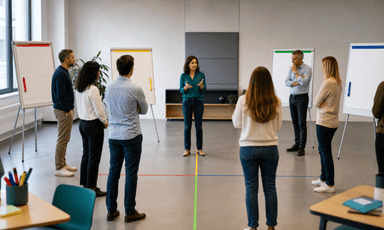
A workshop to explore different communication styles without putting people into boxes.

The facilitator wears three hats and moves between them before and throughout the session.
A creative and immersive icebreaker that stimulates imagination, builds connection, and creates a playful shared moment.
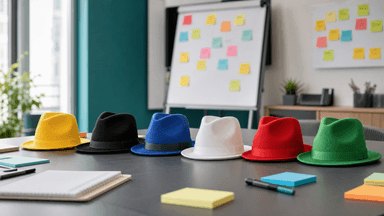
A structured facilitation method to explore a topic or solve a problem through different thinking postures.