

Six Thinking Hats
A structured facilitation method to explore a topic or solve a problem through different thinking postures.
The Six Thinking Hats method helps a group explore a topic or solve a problem in a structured way, by using different thinking postures without mixing registers.
Goal
Support creativity, perspective-taking, and collective decision-making by exploring a topic from several angles.
Principle
Each participant, or the whole group, successively adopts a way of thinking represented by a hat. This avoids sterile debates and premature judgments.
The six hats
Yellow hat
Positive
Identify benefits, advantages, and opportunities.
Black hat
Critical
Highlight risks, dangers, and limits.
Blue hat
Organization
Manage the process, synthesize, and conclude.
White hat
Neutral / Facts
State facts, data, and objective information.
Red hat
Emotional
Express intuitions, feelings, and emotions.
Green hat
Creative
Suggest ideas, alternatives, and new solutions.
Steps to facilitate the workshop
Prepare
- Define the workshop objective: decision, ideation, analysis.
- Invite 4 to 8 people maximum.
- Prepare a board, sticky notes, or a shared note-taking tool.
Introduction
Blue hat- Explain the method and the six hats.
- Set the rules: kindness, one hat at a time, no judgment.
- Define the topic or question to explore.
Hat sequence
- Use a fixed sequence, for example: White, Red, Black, Yellow, Green, Blue.
- Or adapt the order based on the workshop needs.
Format
- All participants wear the same hat at the same time.
- The group practices parallel thinking rather than direct confrontation.
- Duration per hat: 5 to 15 minutes depending on the topic.
- A facilitator guides transitions and reformulates.
Closing
Blue hat- Synthesize contributions.
- Identify one or more decisions or next actions.
- Collect feelings about the workshop.
Classic sequence example
What facts are known? Is information missing?
What emotions, intuitions, or doubts do you have?
What risks, limits, or obstacles do we see?
What benefits, advantages, or opportunities exist?
What alternatives or new ideas can we propose?
What synthesis and next steps?
Benefits
- Reduces emotional pressure.
- Avoids open conflicts.
- Brings out varied and original ideas.
- Strengthens active listening.
Variants
- Sub-groups: one group takes one hat, then shares.
- Role-play: each person keeps one hat for the whole workshop.
Explore also

The facilitator wears three hats and moves between them before and throughout the session.

An effective facilitator does more than run a session: they create the conditions for the group to work well and produce results.
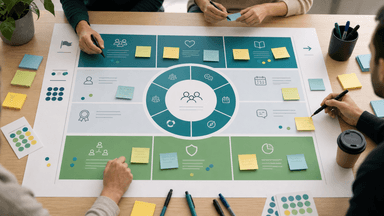
A structuring tool to design or evolve an agile community around identity, experience, and structure.

A peer-learning method to address concrete professional challenges through collective intelligence.